

Save Money on Family Apparel: 7 Proven Strategies
Table of Contents
- Master Cost-Per-Wear Analysis for Smart Purchases
- Build a Capsule Wardrobe for Kids That Works Year-Round
- Shop Secondhand and Thrift Stores for Designer Finds
- Learn Mending and Alteration Techniques to Extend Clothing Life
- How to Budget for Clothing Without Sacrificing Quality
- Find the Best Online Clothing Stores for Families
- Timing Your Purchases: Seasonal Sales and Clearance Strategies
- Frequently Asked Questions
Last Updated: August 31, 2026
Master Cost-Per-Wear Analysis for Smart Purchases
Cost-per-wear divides the purchase price by the number of times you'll realistically wear an item. A $60 hoodie worn 100 times costs just $0.60 per wear; worn five times, it costs $12 per wear (the FTC). This metric reveals that investing in quality basics makes financial sense.
The key is being honest about your family's lifestyle. Will your children actually wear that specialty item, or will it sit in the closet? Stick to versatile wardrobe staples that work across seasons and pair with multiple outfits.
Track items that get heavy rotation. School clothes, everyday t-shirts, jeans, and basic hoodies typically have the lowest cost-per-wear. A quality t-shirt from World of Dreamy's collection, like the Original Boys Dreamy at $45, becomes excellent value when worn multiple times per week throughout the year. Over 150 wears, that's just $0.30 per wear, far better than impulse purchases or trendy pieces worn three times before being abandoned.

Build a Capsule Wardrobe for Kids That Works Year-Round
A capsule wardrobe is a curated collection of versatile, mix-and-match pieces that work together across seasons. Start with neutral base colors: black, white, gray, navy, and khaki. About 70% of your family's everyday clothing should be in these neutrals, reducing decision fatigue and making getting dressed faster (peer-reviewed research).
Add 2-3 accent colors that work with your family's skin tones. These accent pieces break up the neutrals while maintaining cohesion.
Focus on basic pieces that serve multiple purposes: quality t-shirts, long-sleeve shirts, simple sweaters, and plain hoodies. These layer easily and work across seasons. For kids, durability matters more than quantity. Five high-quality t-shirts that survive multiple children and wash cycles beat fifteen cheap shirts that fall apart after one season.
Seasonal pieces should be minimal and strategic. One warm coat, one light jacket, one sweater for layering covers most situations. Avoid buying excessive seasonal clothing that sits unused most of the year.
Shop Secondhand and Thrift Stores for Designer Finds
Secondhand shopping is one of the fastest ways to save money on family apparel, especially for growing children who wear things briefly before outgrowing them. Local thrift stores offer immediate gratification and inventory that turns over constantly. Online marketplaces offer vastly larger selection and the ability to search specific brands, sizes, and styles, though shipping costs eat into savings.
Inspect secondhand items carefully for stains, tears, missing buttons, or wear. Check seams and hems. Secondhand doesn't mean damaged; many items are essentially new, worn only a few times before being outgrown.
Hand-me-downs from family and friends represent the ultimate cost savings. Quality pieces that one child outgrows can serve multiple younger children, dramatically lowering effective cost-per-wear. Create a hand-me-down network with other families through clothing swaps where families bring items their children have outgrown. Everyone leaves with new-to-them pieces at zero cost.
Learn Mending and Alteration Techniques to Extend Clothing Life
Mending and alteration skills extend the life of existing pieces rather than replacing them. A torn seam, missing button, or broken zipper doesn't mean an item is done; it needs 15 minutes of attention.
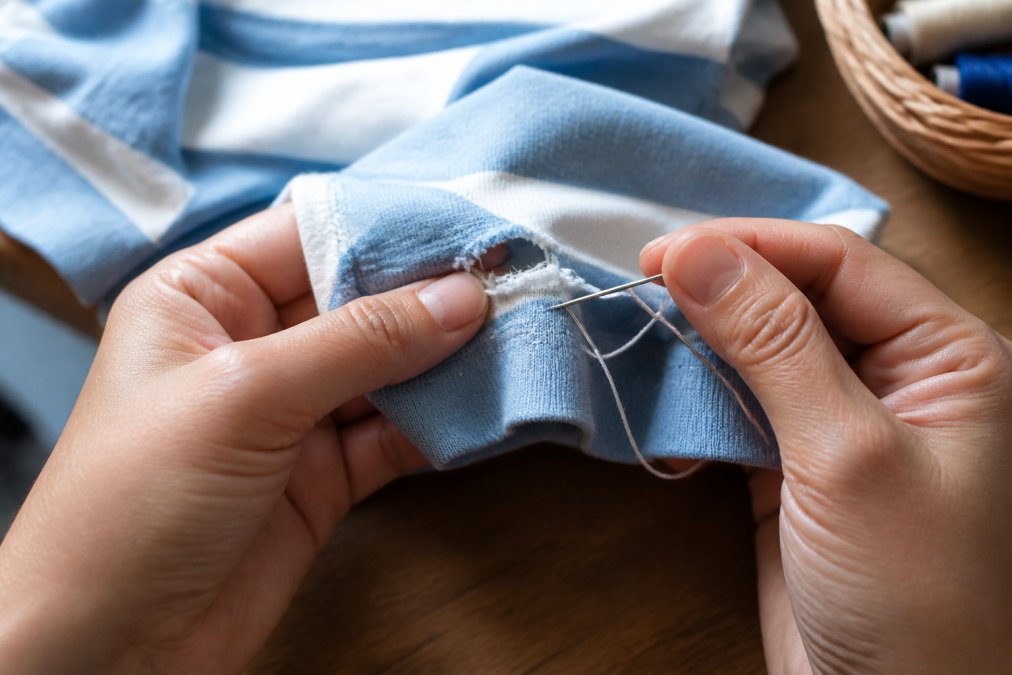
Basic hand-sewing skills cover most repairs: threading a needle, sewing a straight stitch, and securing thread properly handles seams, hems, and button replacements. YouTube tutorials make learning accessible; most repairs take less time than driving to a store to replace the item.
Hemming is particularly valuable for families with growing children. Instead of buying new pants when kids grow, you can let down existing hems or hem pants that are slightly too long. Many children's pants come with generous hems specifically to accommodate growth.
Button replacement is trivial but often overlooked. A missing button makes an otherwise perfect shirt unwearable. Keeping a button jar with extras from old clothing means you can replace lost buttons in minutes.
Zippers fail regularly on children's clothing. Learning to replace a zipper or repair a stuck one extends the life of jackets and hoodies. If the zipper slider is stuck, graphite pencil rubbed on the teeth often frees it.
Fabric care extends clothing life dramatically. Cold water washing, gentle cycles, and air drying preserve fabric integrity far better than hot water and machine drying (the FTC). Act quickly on stains before washing; different stains require different approaches to prevent permanent damage.
How to Budget for Clothing Without Sacrificing Quality
Effective clothing budgeting starts with calculating your actual needs. Track what your family actually wears for one month. This data reveals your true requirements and prevents overestimating needs.
Allocate your budget across categories: basics (most funding), seasonal items (moderate funding), and statement pieces (minimal funding). Basics deserve the most investment because they get worn constantly. A modest budget forces prioritization and improves clothing choices.
Take advantage of seasonal sales strategically. Buy winter coats in January when prices drop. Purchase summer items in August. Off-season buying lets you invest in quality pieces at significant discounts.
Clearance racks offer exceptional value. Retailers mark down items that aren't selling to make room for new inventory. These items often have nothing wrong with them; they're simply unpopular colors or styles.
Discount codes and loyalty programs add up quickly. Sign up for email lists to receive promotional codes. World of Dreamy offers a current 25% discount on their diverse selection of family apparel, including their exclusive Dreamy Origins collection.
Find the Best Online Clothing Stores for Families
Online shopping offers convenience that brick-and-mortar retail can't match, especially for families managing multiple children's sizes. The challenge is finding retailers that deliver on quality, sizing accuracy, and value.

World of Dreamy stands out as a comprehensive option for families seeking diverse apparel across all age groups. Their collection spans everything from comfortable hoodies to essential t-shirts and swimwear, meaning you can shop for the entire family in one place. The Original Boys Dreamy t-shirt at $45 represents their commitment to quality basics that work as wardrobe staples. Their current 25% discount applies across their catalog, including their exclusive Dreamy Origins collection, making quality apparel more accessible for budget-conscious families.
When evaluating online retailers, sizing accuracy matters most. Read customer reviews specifically about fit. Consistent sizing across a retailer's catalog makes repeat shopping faster and reduces return hassles. Return policies determine whether online shopping works for your family. Can you return items easily if sizing is wrong? Some retailers offer free returns, eliminating the risk of ordering items you're unsure about.
Look for retailers offering bundle discounts or family packages. Buying multiple items together often qualifies for additional discounts. Good customer service responsiveness matters when issues arise.
Timing Your Purchases: Seasonal Sales and Clearance Strategies
Strategic timing transforms your clothing budget by aligning purchases with when retailers are most motivated to discount. Seasonal sales follow predictable patterns: winter clothing goes on clearance in January and February, summer items in August and September, and back-to-school sales happen in late July and August.
End-of-season clearance represents the deepest discounts because retailers must clear inventory to make room for new stock. Stores often mark items down 50-70%. The selection is limited, but if you're flexible about colors and styles, the savings justify the compromise.
When retailers introduce new season collections, old season inventory must go. This timing creates a predictable window where you can find quality items at steep discounts.
Flash sales and limited-time promotions reward attentive shoppers. Following retailers on social media or signing up for email notifications means you catch these sales before popular sizes sell out.
Back-to-school season offers particular value for families with school-age children. Retailers compete heavily during this period, offering significant discounts on basics like t-shirts, jeans, and hoodies that kids wear constantly.
Plan ahead by identifying what your family will need in coming months. If you know your child will need new jeans in September, watch for back-to-school sales. This forward planning lets you buy exactly what you need when prices are optimal.
Saving money on family apparel doesn't mean compromising on quality or style. By mastering cost-per-wear analysis, building a functional capsule wardrobe, shopping secondhand strategically, learning basic mending skills, budgeting intentionally, and timing purchases around seasonal sales, you create a system where quality clothing becomes more affordable than fast fashion alternatives. World of Dreamy makes this approach even more accessible with their diverse family apparel selection and current 25% discount across their catalog. Start with one strategy and build from there. Small changes compound into significant savings over time.
== FAQ ANSWERS (audit these too, same rules) ==
[1] Q: What is the cost-per-wear method and how does it save money on family apparel? A: Cost-per-wear divides a garment's price by how many times you'll realistically wear it. A $60 jacket worn 100 times costs $0.60 per wear; a $20 trendy shirt worn twice costs $10 per wear. For families, this shifts focus from cheap prices to durable basics. A higher-quality wardrobe staple worn across multiple seasons and siblings justifies the upfront cost. Track which items your family actually wears repeatedly, then invest in similar styles rather than impulse purchases that sit unworn.
[2] Q: When is the best time of year to buy family apparel to save the most? A: End-of-season clearance sales offer the deepest discounts: July-August for summer inventory and January-February for winter stock. Back-to-school sales in August and holiday promotions in November also provide significant savings. Off-season buying is key, purchase winter coats in spring and swimwear in fall. Many retailers, including online stores offering discounts, add extra markdowns during these windows. Plan ahead by buying next season's sizes in advance, especially for growing children.
[3] Q: How can I build a capsule wardrobe for kids that reduces overall clothing spending? A: A capsule wardrobe for kids focuses on versatile, mix-and-match pieces in a neutral color palette (white, gray, navy, black) plus one accent color. Include basics like plain t-shirts, jeans, neutral sweaters, and simple dresses that work across seasons. This approach cuts decision fatigue and reduces impulse buys. Pieces work across siblings as hand-me-downs. Quality matters here, invest in durable organic cotton or blended fabrics that withstand repeated wear and washing.
[4] Q: What's the difference between fast fashion and slow fashion when budgeting for family clothes? A: Fast fashion prioritizes cheap, trendy pieces that wear out quickly; slow fashion emphasizes quality, durability, and timeless design. Fast fashion items often cost less upfront but deteriorate after a few washes, raising long-term costs. Slow fashion pieces cost more initially but last years and multiple children. For families, slow fashion reduces waste and total spending over time. Look for quality indicators: reinforced seams, natural fabrics, and brand reputation. Online stores offering quality basics at discounts strike a balance between affordability and longevity.
Frequently Asked Questions
What is the cost-per-wear method and how does it save money on family apparel?
Cost-per-wear divides a garment's price by how many times you'll realistically wear it. A $60 jacket worn 100 times costs $0.60 per wear; a $20 trendy shirt worn twice costs $10 per wear. For families, this shifts focus from cheap prices to durable basics. A higher-quality wardrobe staple worn across multiple seasons and siblings justifies the upfront cost. Track which items your family actually wears repeatedly, then invest in similar styles rather than impulse purchases that sit unworn.
When is the best time of year to buy family apparel to save the most?
End-of-season clearance sales offer the deepest discounts: July-August for summer inventory and January-February for winter stock. Back-to-school sales in August and holiday promotions in November also provide significant savings. Off-season buying is key, purchase winter coats in spring and swimwear in fall. Many retailers, including online stores offering discounts, add extra markdowns during these windows. Plan ahead by buying next season's sizes in advance, especially for growing children.
How can I build a capsule wardrobe for kids that reduces overall clothing spending?
A capsule wardrobe for kids focuses on versatile, mix-and-match pieces in a neutral color palette (white, gray, navy, black) plus one accent color. Include basics like plain t-shirts, jeans, neutral sweaters, and simple dresses that work across seasons. This approach cuts decision fatigue and reduces impulse buys. Pieces work across siblings as hand-me-downs. Quality matters here, invest in durable organic cotton or blended fabrics that withstand repeated wear and washing.
What's the difference between fast fashion and slow fashion when budgeting for family clothes?
Fast fashion prioritizes cheap, trendy pieces that wear out quickly; slow fashion emphasizes quality, durability, and timeless design. Fast fashion items often cost less upfront but deteriorate after a few washes, raising long-term costs. Slow fashion pieces cost more initially but last years and multiple children. For families, slow fashion reduces waste and total spending over time. Look for quality indicators: reinforced seams, natural fabrics, and brand reputation. Online stores offering quality basics at discounts strike a balance between affordability and longevity.
This article was written using GrandRanker
Leave a comment