

J.Crew Alternatives for Budget Shoppers: 7 Smart Picks
Table of Contents
- Why J.Crew Prices Keep Climbing (And What to Do About It)
- J.Crew Alternatives for Budget Shoppers: The Quick Comparison
- Everyday Basics That Rival J.Crew at Half the Price
- Refined Styles for Work: Best Places to Buy Work Clothes for Cheap
- The Preppy Aesthetic Without the Designer Markup
- Is Fashion Nova Good for Quality? A Straight Answer
- How to Build a Capsule Wardrobe on a Budget
- What to Ignore When Shopping for Budget-Friendly Style
- Frequently Asked Questions
Last Updated: September 6, 2026
Why J.Crew Prices Keep Climbing (And What to Do About It)
The average shopper now expects to pay a significant premium for a single merino wool sweater or a pair of chinos with a familiar label attached. The truth is that the markup often funds marketing and retail overhead, not necessarily superior fabric or construction.
At World of Dreamy, we track these shifts closely because our entire catalog is built around delivering elevated basics without the designer markup. J.Crew alternatives for budget shoppers exist across every category, from tailored blazers to weekend tees, and most cost a fraction of the retail price while offering comparable or better quality.
Below, we break down where to shop, what to buy, and how to build a wardrobe that looks expensive without draining your savings.
J.Crew Alternatives for Budget Shoppers: The Quick Comparison
A capsule wardrobe built on smart alternatives should prioritize natural fibers, tailored fit, and timeless silhouettes. Here is a quick reference table to match your shopping priorities with the right approach.
| Shopping Priority | Best Approach | What to Look For | Typical Savings |
|---|---|---|---|
| Everyday Basics | Discount retailers and online marketplaces | Cotton tees, chinos, oxford shirts | Significant vs. designer retail |
| Workwear | Off-price department stores and outlet sections | Blazers, trousers, sheath dresses | Moderate to significant |
| Preppy Aesthetic | Pre-owned marketplaces and heritage-inspired brands | Nautical stripes, cable knits, madras | High on pre-owned items |
| Sustainable Options | Eco-conscious labels and resale platforms | Organic cotton, recycled fabrics | Varies by brand |
The best strategy often mixes several sources. The smartest shoppers buy their work trousers from one place, their weekend tees from another, and their statement outerwear from a pre-owned marketplace.
Everyday Basics That Rival J.Crew at Half the Price
Most guides focus on trendy pieces rather than the foundation of a good wardrobe. The real value lies in everyday basics: the plain tees, button-downs, and chinos you reach for weekly.
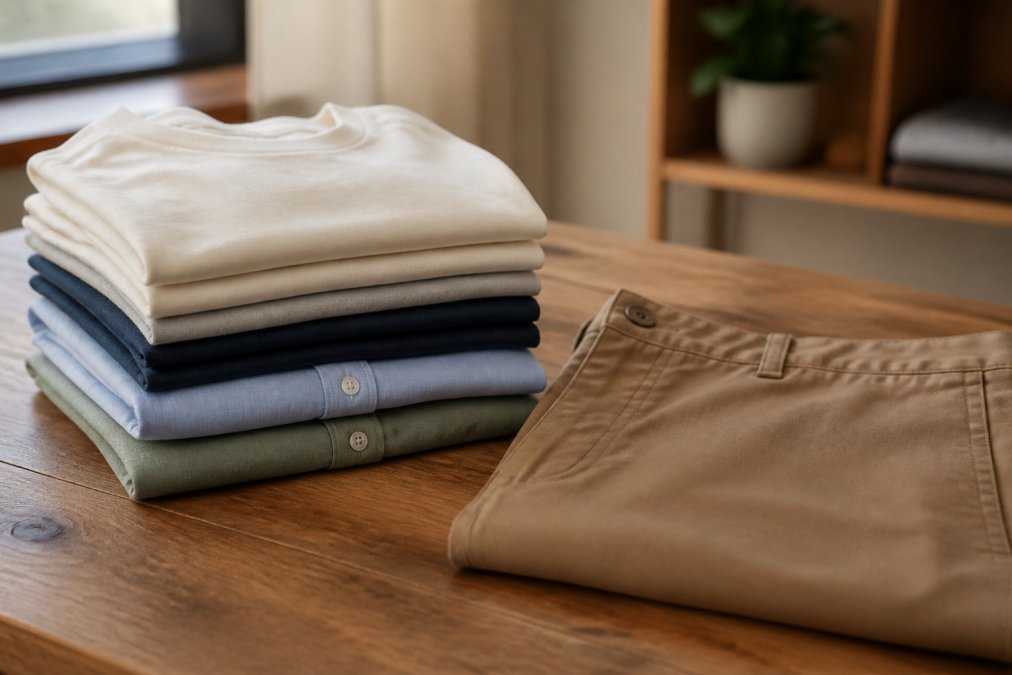
Two factors determine whether a basic is worth your money: fabric composition and fit.
Fabric Composition: The First Filter
Before you look at a price tag, check the care label. The single most reliable predictor of a garment's longevity is the fiber content, not the logo on the collar. Synthetics like polyester and nylon pill, retain odor, and break down faster under regular washing.
Here is what to look for in each core category:
- T-shirts: Target 100% cotton or a cotton-modal blend. A standard cotton tee weighs between 4.5 and 5.5 ounces per square yard. Below 4 ounces, the fabric is likely to be sheer and lose shape quickly. J.Crew's own tees typically fall in the 5-ounce range, so look for that spec on product pages from alternative brands.
- Oxford shirts: The classic oxford cloth is a 100% cotton basketweave. A 40s to 60s single-ply yarn is standard for a shirt that will soften with washing but hold its collar roll. Avoid any oxford that lists a high percentage of polyester in the blend.
- Chinos: Look for a cotton twill with 2% to 4% elastane or spandex. A 6-ounce chino is a year-round weight, while 8-ounce or higher is better for cooler months. Heavier twill also resists bagging at the knees.
Fit and Sizing: What to Expect From Alternatives
A common frustration with budget alternatives is that the fit is unpredictable. Here is a practical guide based on how most budget-friendly brands cut their basics:
- Slim-fit tees: Many discount retailers cut their slim tees with a narrower shoulder and a shorter body length. If you are between sizes, size up to avoid the fabric pulling across the chest.
- Oxford shirts: Look for a cut described as 'classic' or 'regular' if you prefer a fit that allows layering. A 'slim' oxford from a budget brand often runs tighter through the midsection, so check the garment measurements, not just the S/M/L label.
- Chinos: The most common budget-friendly cut is a straight or slightly tapered leg. If you have athletic thighs, look for a 'relaxed taper' or 'athletic' fit.
Cost-Per-Wear: The Math That Matters
The number that matters is cost-per-wear, which is the purchase price divided by the number of times you actually wear the item. Here is how to apply it to basics:
- A $15 tee that you wear 30 times costs $0.50 per wear.
- A $50 tee that you wear 100 times costs $0.50 per wear.
They are equal in value. The difference is that the $50 tee, if made from a heavier cotton with a reinforced collar, is more likely to survive those 100 washes.
A practical benchmark is the 30-wear rule: if you cannot see yourself wearing the item at least 30 times, do not buy it, regardless of the discount. For staples like white tees and chinos, aim for a cost-per-wear under $0.75.
Where to Start Looking
Check the clearance sections of major department store websites first, filtering by fabric content. Search for '100% cotton oxford shirt' rather than a brand name, and sort by price. This surfaces unbranded or house-brand options that often use the same mills as premium labels. For chinos, look for 'cotton stretch chino' and check the fabric weight in the product description.
This approach turns shopping for basics into a spec-driven exercise rather than a brand-loyalty purchase.
Refined Styles for Work: Best Places to Buy Work Clothes for Cheap
Professional settings demand a certain polish, but they don't require designer price tags. The best places to buy work clothes for cheap are off-price department stores and online outlets that carry last season's collections from established brands.
When shopping for workwear, focus on the blazer and trouser combination first. Look for a blazer with a defined shoulder and minimal padding. For trousers, a flat-front style with a slight taper reads as more contemporary than a relaxed fit.
Buy the best quality you can afford in these two categories, then pair them with more affordable shirts and accessories. A well-fitted blazer can elevate an off-the-rack shirt to look entirely custom.
The Preppy Aesthetic Without the Designer Markup
The preppy aesthetic is a visual language of nautical style, classic design, and understated confidence. You can capture it without paying heritage-brand prices by focusing on the signature elements: cable-knit sweaters, oxford cloth button-downs, and chino shorts in seasonal colors.
Pre-owned marketplaces are the single best resource for this look. Because preppy clothing is designed to last, pieces from previous seasons often appear in excellent condition. This approach also aligns with sustainable fashion principles.
Prioritize timeless silhouettes over fashion-forward trends. A classic navy blazer or a white oxford shirt will never look dated, and buying them pre-owned makes them accessible luxury.
Is Fashion Nova Good for Quality? A Straight Answer
Fashion Nova is good for quality if you define quality as trend-forward styling at rock-bottom prices for occasional wear. It is not a good choice if you need durable, natural-fiber basics that will survive a full year of regular rotation.
The brand's business model is built on speed and volume, which means fabric composition often takes a back seat to keeping prices low. For a one-off event piece or a bold seasonal trend you plan to wear a handful of times, that trade-off can be acceptable.
However, for wardrobe staples like white tees, denim, or blazers, the cost-per-wear math works against you. A cheaper synthetic item that falls apart after five wears costs more per use than a slightly pricier cotton version that lasts two years.
How to Build a Capsule Wardrobe on a Budget
Building a capsule wardrobe on a budget is a systematic process. The goal is to create a small collection of versatile clothing where every piece works with several others.
A capsule that only works for one season is not a capsule; it is a seasonal wardrobe that requires a second, equally expensive build six months later.
The Core Palette and the 30-Wear Rule
Start by identifying your core color palette. Neutral tones like navy, gray, white, and olive form the foundation because they mix and match effortlessly. From there, you can add one or two accent colors that reflect your personal style.
The 30-wear rule is a useful benchmark: before buying any new item, ask yourself if you will wear it at least 30 times. If the answer is no, it probably does not belong in a budget-conscious capsule.
The Seasonal Transition Gap
Most capsule wardrobe advice assumes a static climate. In reality, most of the country experiences at least a 30-degree temperature swing between seasons. The solution is to design your capsule around layering pieces that bridge the gap.
Here is the mechanism that works across three seasons:
- The base layer: A cotton or cotton-blend t-shirt in a neutral color. This is your year-round constant.
- The mid layer: An oxford cloth button-down shirt. In warmer months, wear it open over the tee. In cooler months, button it up and add a layer on top.
- The outer layer: A lightweight jacket or blazer in a breathable fabric like cotton twill or a wool blend. This is the piece that extends the capsule into fall and early spring.
This three-layer system means that a single t-shirt can work in July (worn alone) and in November (under the shirt and jacket). You are not buying separate summer and winter wardrobes.
The 5-Piece Transition Formula
To make this concrete, here is a formula that works for a budget capsule across a 50-degree temperature range:
- Two t-shirts in neutral colors (white and navy or gray).
- One oxford shirt in a classic color like light blue or white.
- One pair of chinos in a mid-weight cotton twill (6-8 ounces).
- One layering piece, either a cotton crewneck sweater or a lightweight blazer.
With these five pieces, you can create the following seasonal combinations:
- Warm weather (75°F+): T-shirt alone with chinos.
- Mild weather (60-75°F): Oxford shirt over the t-shirt, sleeves rolled.
- Cool weather (45-60°F): Sweater or blazer over the oxford shirt.
- Cold weather (below 45°F): All three layers, t-shirt, oxford, and sweater or blazer.
Instead of buying a heavy winter coat and a separate set of summer polos, you invest in one versatile layering system that adapts.
Budget Allocation Across the Capsule
Not all five pieces deserve the same budget. Spend more on the pieces that are closest to your body and the ones that carry the most visual weight:
- T-shirts: These are the highest-turnover items. Buy the cheapest 100% cotton option you can find that meets the 5-ounce weight threshold. Expect to replace them every 12-18 months.
- Oxford shirt: This is a mid-tier investment. A slightly higher price for a better cotton weave pays off because this piece is visible in three of the four seasonal combinations.
- Chinos: This is your highest-value item. A well-made pair of chinos in a durable twill will last through years of regular wear. Allocate the largest portion of your budget here.
- Layering piece: This is a medium-term investment. A cotton sweater or blazer should last several seasons if you care for it properly.
Testing Your Capsule Before You Commit
Before you spend any money, do a 'capsule audit' of what you already own. Pull out the neutral-colored pieces and see how many of the seasonal combinations above you can already create. Most people find they are only two or three pieces away from a functional year-round capsule.
What to Ignore When Shopping for Budget-Friendly Style
Retailers use several tactics to push shoppers toward higher spending. One of the most common is the "perceived value" trap, where a slightly higher price makes an item feel higher quality than it is. In reality, the price tag often reflects branding and marketing, not fabric or construction.
Ignore the pressure to buy seasonal collections in full. By the time a trend reaches mainstream stores, it is often about to cycle out. Instead, focus on classic design and timeless silhouettes.
Do not be swayed by aggressive discounting alone. A 25% discount on a poorly made garment is still a poor investment. If the fabric is thin and the stitching is loose, even a steep markdown does not make it a smart buy.
Consumer advice on clothing care and longevity can help you extend the life of your garments, while The EPA's guide on sustainable fashion choices offers insight into reducing textile waste. For a deeper look at cost-per-wear calculations, Harvard Business Review's analysis of consumer spending habits provides useful frameworks for evaluating purchases.
Building a budget-friendly wardrobe that rivals premium brands takes a shift in mindset. Instead of chasing labels, you focus on fabric composition, tailored fit, and the cost-per-wear of every purchase. At World of Dreamy, we apply these same principles across our diverse catalog of apparel for men, women, and children, from stylish swimwear to comfortable hoodies and essential tshirts. Explore our exclusive Dreamy Origins collection and take advantage of our current 25% discount offer to refresh your closet with pieces that balance quality and value.
Frequently Asked Questions
What are some affordable stores similar to J.Crew?
Several stores deliver the J.Crew preppy aesthetic for less. Look for retailers that prioritize natural fibers like cotton and linen, and that offer classic silhouettes such as Oxford shirts, chinos, and knit sweaters. The key is comparing the fabric composition and construction details, not just the price tag. A $40 shirt made with 100% cotton will outlast a $40 shirt made with a polyester blend, so check the label before you buy.
Why is J.Crew so expensive now?
J.Crew has shifted toward a more premium positioning in recent years, focusing on higher-end materials and more tailored fits. This strategy, combined with supply chain costs and a move away from deep discounting, has pushed regular prices upward. For budget shoppers, this means the brand's sale section is less predictable. The smartest approach is to find alternatives that use similar fabrics and construction methods without the brand-name overhead.
How do I identify quality fabrics when shopping for budget clothing?
Check the care label before you check the price. Look for 100% cotton, linen, or wool in most staples. For knits, a higher gauge (more stitches per inch) signals better durability. Avoid anything with more than 30% polyester unless it's a performance piece like activewear. Seams should be straight and reinforced at stress points like the shoulders and crotch. A simple fold test: quality fabric creases cleanly and releases easily, while cheaper blends hold a permanent wrinkle.
How can I build a preppy wardrobe on a budget?
Start with the cost-per-wear calculation. A $60 Oxford shirt worn 50 times costs $1.20 per wear, which beats a $20 shirt that falls apart after 10 washes. Focus on the J.Crew formula: a navy blazer, white button-downs, chinos in khaki or olive, and a quality knit sweater. These five pieces mix and match endlessly. Shop end-of-season sales for the next season's staples, and always size up for blazers to allow for tailoring.
Leave a comment