

Is Discounted Clothing Lower Quality? The Truth
Table of Contents
- Why Discounted Clothing Isn't Automatically Lower Quality
- What Actually Drives Clothing Prices Down
- How to Spot High Quality Clothing on a Discount Rack
- Outlet Store vs Retail Store Quality: What's the Difference?
- Is Fashion Nova Good for Quality? What Fast Fashion Discounts Reveal
- Fabric Composition, Sustainability, and Return Policies
- Frequently Asked Questions
Last Updated: September 13, 2026
Why Discounted Clothing Isn't Automatically Lower Quality
A garment's price tag reflects its retail strategy, not its construction. A jacket marked down from a previous season can be identical in fabric, stitching, and fit to the same jacket sold at full price six months earlier. The discount reflects timing, inventory pressure, and margin math, not a sudden drop in how it was made.
That distinction matters because shoppers routinely mistake price for quality. Here's how the two actually relate.
Discounted clothing is apparel sold below its original retail price, either because it was produced for a discount channel, cleared from prior-season inventory, or priced to move quickly. The reason behind the markdown determines what you're getting far more than the percentage off does.
The question isn't whether discounted clothing is lower quality. It's which kind of discount you're looking at. The 5 sections below break down the difference, plus how to inspect a garment before you buy.
Made-for-Outlet vs. Clearance Merchandise
Made-for-outlet garments are produced specifically for discount channels, often with different materials and simpler construction than the same brand's main-line pieces. Clearance merchandise is main-line inventory sold below original price to clear space.
The two look identical on the rack. They are not.
A common approach among retailers is to run outlet-exclusive production lines using lighter fabric weights, fewer stitch details, and simplified seam finishes. Clearance items, by contrast, started life as full-price goods. The fabric density, stitch count, and hardware are whatever the brand originally specified.
What Actually Drives Clothing Prices Down
Four forces push a price down: end-of-season inventory clearing, overproduction, made-for-outlet production, and promotional pricing designed to drive volume. Only two of those involve any change to the garment itself.
Retail markup is the piece most shoppers never see. A garment's price includes the cost of materials, labor, freight, retail overhead, and the brand's margin. When a retailer cuts the price, it is usually absorbing a smaller margin, not swapping in cheaper materials.
The Truth About Compare-At Pricing
Compare-at pricing is a reference price shown alongside a sale price to signal savings. It does not always reflect what the item actually sold for previously.
Some retailers set an inflated compare-at figure to make a modest discount look dramatic. Others use the genuine original retail price. There is no universal standard, which is why the number alone tells you very little about value. Look at the garment, not the strikethrough.
How to Spot High Quality Clothing on a Discount Rack
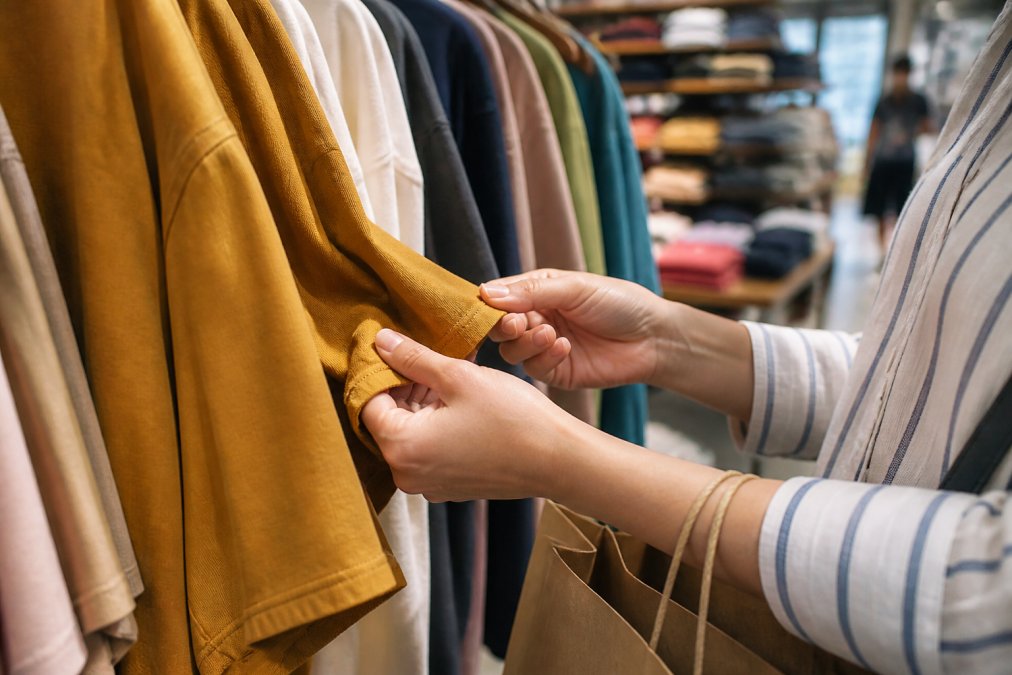
Quality lives in the details you can see and touch in under two minutes. Turn the garment inside out and check four things: seams, fabric density, hardware, and symmetry.
Look for clean, dense stitching rather than loose or skipped threads. Squeeze the fabric; if light passes through easily, the weave is thin. Check that buttons, zippers, and drawcords feel solid, not hollow. Finally, lay the garment flat and confirm both sides match.
A Physical Inspection Checklist
Use this before buying any discounted item:
- Turn the garment inside out and inspect seam integrity
- Check stitch count per inch on a hem or side seam
- Squeeze the fabric against light to judge density
- Test zippers and buttons for smooth, solid action
- Compare left and right sides for symmetry
- Read the fabric composition tag (natural vs. synthetic fibers)
- Rub a hidden area to check for color transfer
- Confirm the return policy before purchase
Outlet Store vs Retail Store Quality: What's the Difference?
Outlet store and retail store quality often differ because many outlets stock made-for-outlet production, while retail stores carry main-line goods. The gap is real but not universal.
Some brands ship genuine overstock to outlets. Others produce outlet-exclusive lines with cost-cutting measures built in from the start. The tell is the same as before: check the style number against the brand's main catalog. If it doesn't appear there, it was likely made for the outlet.
Is Fashion Nova Good for Quality? What Fast Fashion Discounts Reveal
Fast fashion discounts reveal a business model built on speed and volume, not durability. Frequent sales are central to that model, not a signal of hidden defects. The honest answer on whether Fashion Nova is good for quality depends on what you expect, but the more useful answer is why the construction differs, because that mechanism is what lets you judge any fast-fashion discount, not just one brand.
The Speed-to-Shelf Mechanism
A traditional apparel line runs on a calendar measured in seasons: design, sampling, fabric sourcing, production, and shipping are planned months ahead. A fast-fashion line compresses that cycle to weeks. Three cost levers make the compression possible:
- Fabric substitution. When a trend is identified, the fabric is often sourced from whatever mill can deliver fastest, which favors polyester, rayon, and blends over natural fibers with longer lead times. A 95% polyester / 5% spandex knit is cheap, stretches predictably, and pills under friction, that trade-off is built in, not accidental.
- Construction shortcuts. Fewer stitches per inch, serged rather than finished seams, and fused (glued) instead of sewn interfacing all reduce labor minutes per garment. A fused collar or waistband can delaminate after repeated washing in a way a sewn one will not.
- Trim downgrade. Plastic zippers, hollow buttons, and thin elastic are the first components to fail. They are also the cheapest to swap, which is why they are the most common cost lever.
None of these are defects. They are the predictable output of a model optimized for trend velocity. The question is whether the price you pay reflects that trade-off honestly.
What This Means for Any Fast-Fashion Discount
A frequent sale is not evidence of a hidden flaw, it is evidence of high inventory turnover and margin math that assumes most items are worn for a season, not a decade. If you want a piece to last years, expect to pay for fabric density and construction. If you want a current look for a season, fast fashion delivers exactly that.
The practical move is to inspect the specific garment, not the brand. The same retailer can sell a well-constructed denim jacket and a disposable mesh top in the same order. Use the physical inspection checklist above on each item individually.
Fabric Composition, Sustainability, and Return Policies
Fabric composition is the single most predictive quality signal available to a shopper. A tag reading 100% cotton behaves very differently from one reading 60% polyester, 40% rayon, regardless of price. Here is how to actually read the tag and what each fiber tells you about how the garment will age.
How to Read a Care Label Like a Textile Buyer
The fiber content tag is regulated: the Federal Trade Commission's textile and wool rules defines what fiber content disclosures are required and in what order. Fibers are listed by weight, highest first. That order is the fastest read on quality.
Natural fibers (cotton, linen, wool, silk):
- Cotton breathes, holds shape, and softens with washing. Long-staple cotton (often labeled Pima or Supima) resists pilling far better than short-staple cotton, which is why two 100% cotton shirts can feel completely different.
- Linen is strong and breathable but wrinkles by design. It gets softer over time rather than degrading.
- Wool resists odor and holds warmth when wet. Fine-gauge merino is durable; coarse wool felts and shrinks if washed wrong.
- Silk is strong for its weight but degrades with sunlight and harsh detergents.
Synthetic fibers (polyester, nylon, acrylic, spandex):
- Polyester is durable and wrinkle-resistant but traps odor and pills under friction. It is the most common cost-reduction swap in fast fashion.
- Nylon is strong and abrasion-resistant, good in outerwear, less breathable in next-to-skin layers.
- Acrylic mimics wool at a fraction of the cost but pills quickly and loses shape.
- Spandex (elastane) adds stretch. A small percentage (2-5%) is normal; higher percentages often signal a garment engineered to fit loosely and rely on stretch for shape.
Blends are not automatically worse. A cotton-poly blend can be more durable than pure cotton because the polyester resists shrinking and wrinkling. The red flag is a blend used to hide a thin weave, which is why you should always pair the tag with the squeeze test above.
Sustainability: The Lower-Impact Case for Discounted Clothing
From a sustainability standpoint, buying discounted clothing is often the lower-impact choice. Extending a garment's product lifecycle by purchasing clearance or secondhand inventory keeps apparel out of landfills and avoids the resource cost of producing a new item. The environmental math favors wearing what already exists over manufacturing more.
The caveat is that a discount on a poorly made garment you wear twice is not sustainable, it is just cheap. The sustainability benefit only materializes if the garment actually gets worn. That is why the inspection checklist above matters for the environmental case as much as the financial one.
Consumer transparency matters here too: brands that disclose fiber content and sourcing give you the information to choose well. When a brand hides fiber content behind vague marketing language, treat that as a signal.
Return Policy Nuances at Outlet and Discount Stores
Return policy nuances deserve your attention before checkout, and outlet-specific policies are where most shoppers get burned. A generous discount paired with a short return window shifts risk onto you. Three patterns are common:
- Outlet-exclusive items are often final sale. Because made-for-outlet merchandise carries a different SKU, many retailers exclude it from the standard return window even when the same brand's main-line items are returnable.
- Return windows are shorter at outlet locations. A 30-day main-store window may become 14 days at the outlet, and the clock may start at purchase rather than delivery.
- Return shipping is frequently on you for online outlet orders. A discount that looks like 40% off can shrink to 25% off once return shipping is factored in if the item does not fit.
Confirm four things before you buy: whether returns are accepted at all, who pays return shipping, whether sale or outlet-exclusive items are excluded, and whether the return must be in-store. The Federal Trade Commission's guidance on refund and return policies outlines what sellers must disclose, and the Consumer Financial Protection Bureau's consumer resources explains your rights when a purchase goes wrong.
Frequently Asked Questions
Is clothing sold at outlet stores lower quality than retail stores?
Not always, but often. Many outlet stores sell made-for-outlet merchandise produced specifically for discount channels, using thinner fabrics and simpler construction. However, some outlets also carry genuine clearance items from main retail lines. Check the label for fabric content and examine seam integrity to tell the difference.
What does 'compare at' pricing actually mean?
Compare-at pricing is a retail strategy that shows a higher original price next to the sale price. The original figure may reflect the manufacturer's suggested retail price, a price the item never actually sold at, or a competitor's price. It is not a guarantee of value. Focus on the actual price and the garment's construction rather than the anchor number.
How can you tell if a garment is well-made?
Check the fabric density by holding it up to light, inspect seam integrity for loose threads or uneven stitching, and look at stitch count per inch. Higher stitch counts (8-12 per inch) generally indicate better construction. Also check color fastness by rubbing a damp cloth on a hidden area to see if dye transfers.
Are online discounts indicative of lower fabric quality?
Online discounts can signal overstock, end-of-season clearance, or promotional pricing rather than inferior materials. However, some fast fashion retailers do use lighter synthetic fibers and cost-cutting measures to sustain deep discounts. Read fabric composition details and customer reviews about durability before buying.
Discounted clothing isn't a quality gamble when you know what to inspect. The real challenge is finding a retailer that offers genuine markdowns without cutting corners on the garments themselves. That's where World of Dreamy comes in: a diverse selection of apparel for the whole family, an exclusive Dreamy Origins collection, and a current 25% discount offer, all backed by a convenient online shopping experience. Get started with World of Dreamy and shop quality apparel at a real discount.
Leave a comment