

How to Spot High Quality Clothing: 2026 Guide
Table of Contents
- Why Spotting Quality Matters in 2026
- How to Check Fabric Quality: Fibers That Last
- How to Tell If a Garment Is Well Made: Construction Clues
- Signs of Poor Quality Clothing You Should Never Ignore
- How to Spot High Quality Clothing When Shopping Online
- Checking Hardware, Buttons, and Finishing Details
- How to Spot High Quality Clothing in Second-Hand and Thrift Stores
- Conclusion: Build a Wardrobe That Lasts
- Frequently Asked Questions
Last Updated: September 15, 2026
Why Spotting Quality Matters in 2026
Fast fashion has trained a generation of shoppers to treat clothing as disposable, which makes knowing how to spot high quality clothing a genuinely useful skill again. The Federal Trade Commission's guidance on textile and care labeling requires accurate fiber content disclosure, which gives you a legal baseline to check against. Below, we'll show you exactly how to inspect a garment in under two minutes, in-store or from your couch.
The five checks that follow cover fabric, construction, hardware, fit, and care. They work on a $50 tee and a $500 jacket alike.
How to Check Fabric Quality: Fibers That Last
Fabric quality comes down to fiber content and density, and both are readable before you ever try something on. Check the fiber content tag first: natural fibers like cotton, linen, and wool generally breathe and age well, while synthetic blends can pill and hold odor. A common mistake is assuming a high price guarantees natural fibers. It doesn't.
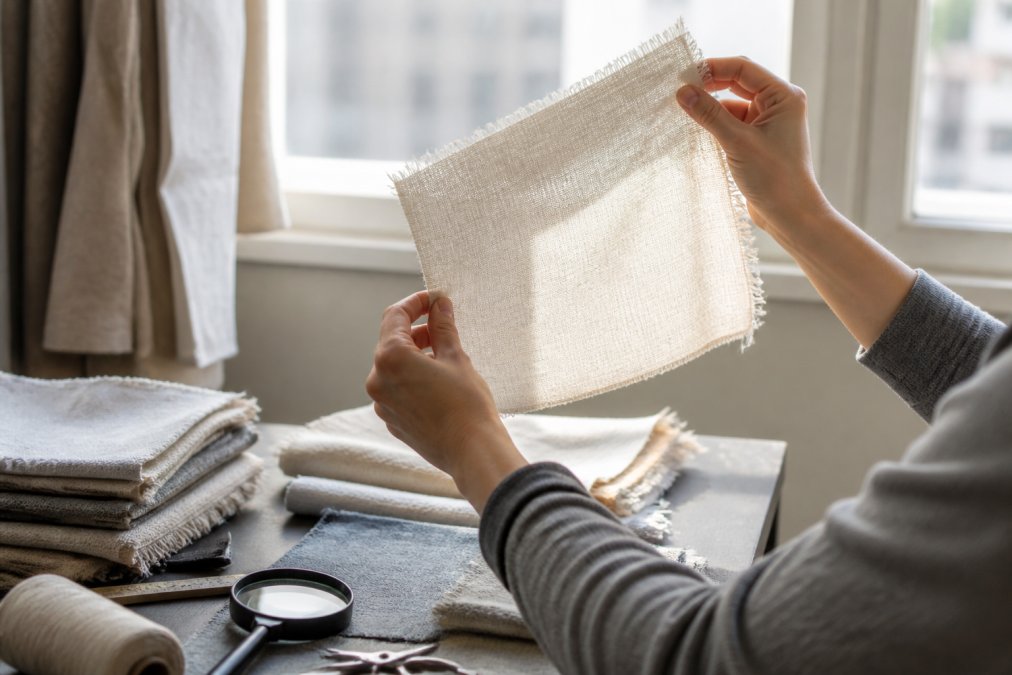
The Pinch Test and Transparency Test
The pinch test and transparency test reveal fabric density without any equipment. Pinch a single layer of fabric between your fingers and hold it up to light. If you can see your hand clearly through it, the weave is too loose for everyday wear. If it holds its shape and blocks most light, the fabric has real density.
Run the same test on a seam. Thin fabric at a seam means the garment will fail there first. This is the single fastest way to tell if a garment is well made before you spend a cent.
How to Tell If a Garment Is Well Made: Construction Clues
Construction tells you more about longevity than the label ever will. Turn the garment inside out and look at how it's put together. Serged edges are standard on knits, but a well-made piece also has clean seam allowance, consistent stitch density, and reinforced stress points at the shoulders, armholes, and crotch.
Seam Allowance, Stitch Density, and Stress Points
Seam allowance is the fabric margin left beyond the stitch line, and it should be wide enough to prevent fraying. Stitch density matters too: 10 to 12 stitches per inch is a solid benchmark for durable seams, while sparse stitching signals a garment built to fail (astm.org). Check stress points for bar tacks or reinforcement stitching. A yoke construction on a shirt or jacket should sit flat with no puckering.
Signs of Poor Quality Clothing You Should Never Ignore
Poor quality shows up in predictable places, and once you know them you can't unsee them. Loose threads at every seam, mismatched patterns at the side seams, and buttons sewn on with a single pass of thread are all red flags. So is a hem that waves instead of lying flat, or a lining that hangs lower than the shell.
Watch for these specific signals:
- Pilling on a new garment, which means short-staple fibers that will only get worse
- Crooked topstitching that wanders off the seam line
- Cheap interfacing that bubbles or wrinkles at the collar and placket
- No care label or a label with vague fiber content
- Asymmetrical cut, where one sleeve or leg is visibly longer
Any one of these alone isn't fatal. Three or more on the same garment means walk away.
How to Spot High Quality Clothing When Shopping Online
Online shopping removes touch, so you have to read differently, and the reading is where most shoppers get fooled. The fiber content tag is your first filter, but the words on that tag are not neutral. "Cotton blend" can mean 95% cotton or 60% polyester, and brands are not required to lead with the dominant fiber in marketing copy. The Federal Trade Commission's guidance on textile and care labeling requires accurate fiber content disclosure on the label itself, so the label, not the product description, is the document you trust.
Decoding Fiber Claims and Spotting Greenwashing
Learn the vocabulary that signals a real material versus a marketing one. "Organic cotton" is a regulated claim only when backed by a certification such as GOTS or USDA Organic; without a certifier named, treat it as aspirational. "Bamboo" on a tag almost always means rayon or viscose, because raw bamboo fiber is rarely used in apparel, the FTC has repeatedly warned brands about this substitution. "Recycled" without a percentage is meaningless; look for a number like "100% recycled polyester" or "40% recycled content." "Eco-friendly," "sustainable," and "green" are not regulated terms and carry no legal weight.
A practical rule: if a listing uses three or more unregulated sustainability words and names zero certifications, the fiber story is marketing, not material. Cross-check the care label against the fiber claim, a garment labeled "100% linen" that recommends dry clean only is a contradiction worth questioning.
Reading Product Photos Like an Inspector
Zoom into the same construction details you would check in person. Look for visible topstitching along hems and armholes, clean seam lines with no puckering, and buttons that sit flush against the placket.
| Check | What to Look For | Red Flag |
|---|---|---|
| Fiber content | Specific percentages, named fibers | "Blend" with no breakdown |
| Certifications | GOTS, USDA Organic, OEKO-TEX named | "Eco-friendly," "green," "sustainable" |
| Detail photos | Close-ups of seams, hems, inside | Only styled model shots |
| Return policy | Clear, standard window | No returns or final sale only |
| Care label | Matches fiber claim | "Dry clean only" on a natural-fiber basic |
| Price vs. claims | Consistent with materials | Premium price, thin fabric |
Assessing Repairability Before You Commit
Checking Hardware, Buttons, and Finishing Details
How to Spot High Quality Clothing in Second-Hand and Thrift Stores
Reading Wear Patterns: Cosmetic vs. Structural
The Repairability Score: Is It Worth Tailoring?
The Slow-Fashion Lifecycle Test
Conclusion: Build a Wardrobe That Lasts
Frequently Asked Questions
What is the pinch test for fabric quality?
The pinch test checks fabric density and drape. Pinch a small section of the garment between your thumb and forefinger. Quality fabric holds its shape and feels substantial without being stiff. If the fabric feels thin, flimsy, or you can see light through it easily, that is a sign of low fabric density. This simple test helps you spot high quality clothing before you buy, especially on items like t-shirts and hoodies where fabric hand matters most.
How do natural fibers compare to synthetic materials in terms of quality?
Natural fibers like organic cotton, linen, and wool offer breathability, softness, and better long-term durability when woven well. Synthetic blends, like the 80% cotton and 20% nylon in The Dreamer Shorts, add stretch and shape retention. Neither is automatically better. The key is fiber content relative to the garment's purpose. A 100% organic cotton tee, like the Dreamy Stitch, works for warm weather, while a cotton-nylon blend suits activewear. Check care labels for fiber content and look for certifications like GOTS, which verify organic standards.
Does a higher price tag always mean better quality clothing?
No. Price reflects brand positioning, marketing, and retail markup as much as construction. A $200 shirt can have the same seam allowance and stitch density as a $50 one. Instead of trusting price alone, inspect fabric density, seam finishing, and hardware. Brands that invest in garment construction, like taped seams and reinforced stress points, tend to deliver better value regardless of price. Focus on what you can see and feel, not the number on the tag.
What should I look for when checking clothing seams and stitching?
Turn the garment inside out and examine the seams. Quality pieces use tight, consistent stitch density with no loose threads or skipped stitches. Look for serged edges or taped seams, which prevent fraying and add durability. Stress points like shoulders, armholes, and crotch seams should have reinforcement. Topstitching along hems and necklines should be even. If seams pucker, feel weak, or show gaps, that is a sign of poor garment construction and a reason to pass.
How can you tell if a garment is well-constructed?
A well-constructed garment has clean seam finishing, matched patterns at seams, and a lining that hangs without twisting. Check that buttonholes are dense and cleanly cut, zippers glide smoothly, and interfacing gives collars and cuffs structure without bulk. Hem finishing should be even, and the garment should hold its shape on a hanger. Brands that use taped seams, like the Original Von Dreamy Black tee, show attention to construction that keeps the garment looking new after repeated washes.
What are the signs of high-quality fabric?
High-quality fabric feels substantial, drapes well, and resists pilling and color fading after washing. Look for tight weave density, a smooth fabric hand, and minimal transparency when held to light. Natural fibers like organic cotton or French terry cotton, used in the Dreamy Zip Hoodie, offer softness and durability. Check care labels for fiber content and certifications. Fabric that feels thin, scratchy, or shows visible gaps in the weave will not hold up to regular wear and washing.
Leave a comment